Showing posts with label comics. Show all posts

Thursday, 29 February 2024

My Brother the Mekon and Other Thrilling Space Stories

I contributed a couple of articles to online magazine Journey Planet, for their Dan Dare issue - #22 - in May 2015. This is one of my shallow dives into pop culture, padded out by some personal perspective and childhood nostalgia.

The other article is here:

* * *

When I was growing up, space was American. I was born the year of the Apollo moon-landing and in my childhood, all astronauts were American, both real and fictional. Neil Armstrong, Buzz Aldrin, the other guy, Steve Austin, even the Fantastic Four. It was years before I realized that for a time, at least in fiction, space had been somewhat British, in the form of Dan Dare and the Interplanet Space Fleet.

So I had absolutely no frame of reference when, on a family holiday on the Isle of Wight, my parents’ friend Dave popped my younger brother on top of his new stubby surfboard, hoisted boy and board up high and proclaimed him to be ‘the Mekon’. I had no idea what he was going on about, but apparently Dave was onto something because my dad seemed to agree that a skinny child in his swimming trunks sat atop an oval of toughened polystyrene was indeed compellingly Mekonish. I think, though memory may be betraying me here, that they got him sit cross-legged and drape his hands over his knees, just to compete the look. Certainly the two grown men then proceeded to parade him at shoulder-height across the beach, for we children were informed that this Mekon ‘hovered on a sort of flying disc’.

This then was my first encounter, however bizarrely, with the world of Dan Dare, and just goes to show what sort of impression his original adventures in Eagle comic had had on my father’s generation. As a sidenote to this I would recommend reading Eugene Byrne and Kim Newman’s excellent short story Teddy Bears’ Picnic, set in an alternate timeline where Britain rather than America fights the Vietnam War. In the story, the hapless soldiers - having grown up in 1950s Britain on a diet of Eagle comics - coin their own slang for the Viet Cong enemy - Treens. It makes sense that in an alt-history world where British lads are fighting in the jungles of Southeast Asia, that the Mekon’s alien race would become a dehumanising word for the enemy.

But I digress. Growing up in the 70s, kids like me learnt a few things ass-backwards: Paul McCartney was that guy from Wings who we only later discovered had been in some pre-Mull of Kintyre group called the Beatles; World War Two was all the rage thanks to endless repeats of Colditz, The Battle of the Bulge and Dad’s Army on telly whilst its predecessor World War One barely got a look-in; and Dan Dare was the widow’s-peaked, luxuriantly-maned action hero of early 2000AD progs - complete with a cool metal hand - rather than the clean-cut gent in a green uniform from our parents’ Eagle comics.

The Dan of 2000AD was a pretty cool character I thought, especially when the art duties had passed from Massimo Bellardinelli to Dave Gibbons, who gave him a much nicer haircut and that awesome metallic hand glove thing. As with the Mekon turning out to be a green dome-headed Treen, it was years before I found the metal hand glove thing was actually called the Cosmic Claw. Gibbons’ Dan looked more than a little like Lewis Collins, riding high at the time as one of the action stars of The Professionals on ITV. But 2000AD’s Dan stories didn’t really grab me, not as much as the mayhem, lunacy and mega-violence of the comic’s rising star Judge Dredd, and I don’t think I blinked an eyelid when he faded away with prog 126. By the following week, I was too engrossed in the adventures of new character Black Hawk - a Roman gladiator forced to fight aliens - to wonder whatever happened to the Pilot of the Future.

Fast forward many years, much as Dan himself did between Eagle and 2000AD, and I am now writing for Crooked Dice Games, founded by Graeme Dawson and my best friend Karl Perrotton. Their flagship game, a skirmish / roleplaying system called 7TV, draws on classic elements of cult TV and film, primarily British sci-fi, fantasy, and spy genres like Dr Who, James Bond and The Avengers. We used the conceit of a fictional television company that existed in the 60s and 70s to give the game both a rich shared universe between the ‘shows’ and to create an entertainingly tongue-in-cheek ‘real-life’ production history, where I indulged myself by casting actual actors, stuntmen and directors from the period to populate our made-up programmes. As an illustration, I cast hardman actor James Booth as the no-nonsense London copper Frank Skelton, and the boyish Hywel Bennett as DS Lenny Kennedy, in the Sweeneyish crime show The Beat.

In 2011, we started work on a chunky gaming supplement for 7TV called On Location, which would expand the core rules beyond the central settings which had tended towards extinct volcanic lairs and crime-ridden London streets. One of the new locations we would be covering was space, but from a strictly cult TV, pre-Star Wars viewpoint, so we needed to create a suitable show to personify the setting, which is where the spirit of Dan Dare re-enters the story.

Karl had already introduced the concept of A.R.C., the Albion Rocket Consortium, in the core rulebook, with an episode of our ‘UNIT-without-the-Doctor’ show Department X. In ‘The Shadow Over Space’, the department’s star agents Dr Hugo Solomon (played against type by legendary actor David Warner) and Pandora King (Jenny Hanley off of Magpie) joined forces with A.R.C.’s Dr Melody Lake to investigate sabotage aboard the lunar shuttle’s maiden voyage, uncover a secret cult and ‘face an ancient horror from beyond the stars’. So when we got round to developing a space show for On Location, A.R.C. was a natural fit.

We already had the basic concept for A.R.C., taking Quatermass’ fictional British Rocket Group and creating adventurous female rocket scientist Dr Lake for the starring role, played by the gorgeous Diana Rigg at the height of her powers. Now we set about fleshing out the show with cult sci-fi elements - from TV, radio and of course Dan Dare - to give it a unique blend that would feel not only like a loving homage to those influential sources, but also we hoped that would come across as a plausible - though sadly non-existent - show from the late 60s and early 70s.

Working with Karl and artist extraordinaire Wayne Peters, I had a fine old time creating a complete world, or more accurately solar system, for Dr Lake, Professor Kneale and the rest of the A.R.C. crew, from the lunar base Guinevere and rocketship Percival to alien threats like the sinister cerebral Venusian and his warlike Kreeg soldiers, and the faceless Martian force known only as ‘the Enemy’.

To give the show just the right look and feel of the genuine article - maybe around the late 60s as with other 7TV creations - we went the extra mile to come up with authentic-looking TV listings, script excerpts and even an Eagle-style double-page splash of the Percival, complete with knowingly-named technical details. Thus I present to you these following selections from 7TV’s A.R.C. series. Points will be awarded for every homage or shout-out you can spot.


5.45 Colour

A.R.C.

starring Diana Rigg

Darc Side of the Moon

by KIT PEDLER

Melody’s ship experiences a series of unexplained malfunctions whilst surveying a remote lunar region. Are they mere accidents, deliberate sabotage or the work of some sinister external force? When radio contact with Guinevere base is lost followed by a complete power blackout, tempers fray and suspicions grow that someone on board is not who they seem…

Dr Melody Lake                 DIANA RIGG

Cpt Jock Hampson             PATRICK MOWER

Valentine                            DAVID McCALLUM

Spinnaker                            ANTHONY MARRIOTT

Fred Roberts                       DAVID JACOBS

The Enemy (voice)            DONALD GRAY

Producer CHARLES CHILTON

Director GERRY ANDERSON


- A.R.C. -

- Darc Side of the Moon -


SCENE 9. MERLIN, EXTERIOR

An A.R.C. Merlin class transport seen from directly above, against the Moon's hidden face, cratered, shadowy and inhospitable. The Merlin seems to hang motionless against the lunar backdrop, as lifeless as the Moon itself.


SCENE 10. MERLIN, INTERIOR

The ship's cockpit, in near total darkness, save for dim starlight from the cabin windows and that of an electric torch, currently waving around somewhere under the pilot's control panel. Intermittent grunting and muttered curses emanate from somewhere down in the pilot's footwell, near the torch's beam.

It is Jock HAMPSON, on his back as if inspecting the underside of a car, holding the light in one hand and unscrewing an instrument panel with the other. A pair of smart feet appear behind him out of the darkness, followed by the disembodied voice of security officer Mr VALENTINE.


VALENTINE (in a clipped tone)

Haven't you finished that yet?


HAMPSON jerks with surprise, hitting his head on the instrument panel and swearing in equal amounts of pain and irritation.


HAMPSON (through gritted teeth)

It'd go a lot bleedin' faster if you didn't keep creeping up on me like that!


VALENTINE's eyes narrow and he is about to issue an acerbic retort when Dr Melody LAKE emerges from the darkened mid-deck.


LAKE

Enough, both of you. I can't worry about the ship and you pair at the same time.


She breaks into a smile and adopts a mocking, schoolteacherish tone.


LAKE

Don't make me come over there and make you sit apart. Now, was there something you needed, Spinnaker?


She turns back to the mid-deck, where technician SPINNAKER is standing in the darkness, his back to LAKE. Obscured by SPINNAKER's head, there is a faint reddish glow.


LAKE

Spinnaker..?


5.45 Colour

A.R.C.

starring Diana Rigg

Spaceship Venus

by GERRY DAVIS

A spaceprobe inexplicably plunging into the Sun is the first indication that all is not well with the solar system’s second planet, but soon Professor Kneale deduces that it is moving out of orbit, threatening to extinguish all life on Earth! The crew of the Percival, struggling to endure the fearsome heat of the Venusian desert, are mankind’s only hope of survival.

Dr Melody Lake                 DIANA RIGG

Professor Victor Kneale    JOHN MILLS

Valentine                            DAVID McCALLUM

Zara                                     WENDY PADBURY

The Venusian                     MICHAEL WISHER

Kreeg Overseer                  PAT GORMAN

Producer INNES LLOYD

Director VAL GUEST           


- A.R.C. -

- Spaceship Venus -


SCENE 12. VENUSIAN DESERT, EXTERIOR

The Sun, so much bigger in the sky than they are used to, beats down upon the A.R.C. crew as they trudge doggedly on. As blinding sunlight reflects off the metal of their suits, Dr Melody LAKE, ZARA Kneale and Mr VALENTINE find themselves navigating a series of deep, dusty dunes, not unlike quarries found back on Earth.


ZARA (panting a little)

Can't we rest a bit, Doctor? I'm terribly tired.


LAKE

Just a little further sweetie, I think I spotted some sort of structure in the distance where we can have a sit-down in the shade.


Mr VALENTINE, walking ahead of the other two, gives the tiniest of sniffs at this. He knows as well as LAKE that shelter from the harsh desert is a long, long way off.


EFFECT: A distant high-pitched humming coming closer.


Mr VALENTINE turns to the approaching sound then drops to a crouch, motioning for the others to do the same. Both he and LAKE draw their pistols as they squint up the slope of a dune to where the humming noise now emanates.


EFFECT: Clouds of sand blow down off the top of the dune, as if a helicopter were landing somewhere out of sight.


The humming dies down as the three astronauts cautiously crawl to the top of the dune and peer over the sandy ridge. Not far away, a curious metallic platform seems to have settled on the sands. It is flat and disc-like, about the size of a car, with a single rail running around at waist height. It seems to have settled into a shallow dusty depression of its own making.

Disembarking from the hover disc are four alien KREEGS - hairless, wide mouthed and devoid of expression. Each one unslings an odd lamp-like device as they fan out, searching the dunes.


ZARA (panicky)

They're bound to find us! We've got to get away!


LAKE (laying a reassuring hand on ZARA's arm)

Tish, but we haven't introduced ourselves yet! Mr Valentine, if you wouldn't mind..?


VALENTINE nods at her unspoken suggestion and scrambles back down the dune, circling around. LAKE straightens up, dusts herself down and begins walking over to the nearest KREEG.


How many did you get? Did you spot our nod to the Mekon, and who I cast as the actor to play him, and why?

As Dan Darish as A.R.C. is, our most obvious homage to the Pilot of the Future appears in another 7TV show altogether. Bluntly pitched as ‘Charlie’s Angels meets Thunderbirds’, The Daredevils stars three sisters - glamourous Diana, roguish Katrina and tomboy Charlie - who have inherited their father’s love of high-flying adventures. Aboard their futuristic Dareplanes, these fearless female flyers respond to emergencies around the world at the behest of their perpetually off-screen daddy, who communicates with his ‘devils’ via long-distance speakerphone.

The family name? Dare, of course.


- THE DAREDEVILS -

- Operation Skyhawk -


SCENE 1. DARE MANOR, INTERIOR. NIGHT.

Night-time in stately Dare Manor.

PAN across the hallways, reception rooms and gallery and library.

Moonlight through tall leaded windows illuminates suits of medieval armour, stuffed animal heads, portraits and opulent furniture.

PAN past a framed photograph of three young girls grinning for the camera, a man kneeling behind them, his face obscured by a replica spacecraft standing in front of the photo.


Thursday, 4 January 2024

Who Watches the Squadron Supreme?

This article first appeared in Journey Planet #77, December 2023.

Squadron Supreme was a 12-issue Marvel limited series that came out in 1985-1986, predating Watchmen by about a year. Written by Mark Gruenwald and (toward the end of its run) drawn by Paul Ryan, it had none of Alan Moore's multi-layered storytelling nor Dave Gibbons' beautifully clean draughtsmanship. But coincidentally, it did ask a few of the same questions, like: Is it safe to hang around superhumans who are in effect walking nuclear reactors? When superhumans fight in most comics, how come nobody gets seriously injured or even dies? What if superheroes really affected the world and how society works? And what if some of them decided that leaving ordinary human governments to run the planet just wasn't working out?

The Squadron's origins begin back in Avengers #85 in 1971, as both an alternate-Earth version of the villainous Squadron Sinister and as a pastiche of DC's flagship Justice League of America, with alien powerhouse Hyperion modelled on Superman, caped crimefighter Nighthawk on Batman, Doctor Spectrum on Green Lantern and so on. As they sporadically guested in various Marvel titles, more Squadron members would be added to parallel the JLA's evolving line-up. Thus we had Arcanna for Zatanna, Nuke for Firestorm and so forth. Prior to the limited series, the Squadron's Earth (or at least the USA: like many American comics at the time they rarely made a distinction) had been devastated by an alien super-intelligence (Defenders #112-114), leaving society in a very sorry state.

In an ongoing 'Marvel Earth' comic (stories set on the world shared by Spider-Man, the Avengers, the X-Men etc), that sort of devastation would have been handwaved by the start of the next storyline; perhaps an opening page or two showing the heroes clearing up rubble and reporting that the President is back in charge, and then onto the next plot. But given that Squadron Supreme is set on an alternate Earth, writer Gruenwald had the opportunity to pretty much do what he wanted with the planet and its greatest heroes over the next twelve issues. And that's just what he does, examining the questions I posed earlier as the Squadron looks at the world with its war, crime, disease and death, and decides to use their great powers and resources to make actual, world-changing differences by instituting their so-called 'Utopia Program'.

Assuming control of the United States, they outlaw guns, get to work on a cure for cancer, establish behavioural modification on criminals and introduce cryogenic 'hibernaculum' chambers for people with incurable conditions. At first, the Utopia Program is a success, even if some of the Squadron's members don’t seem to be fully on board with the 'benevolent dictatorship' approach that they have imposed on society. Things go bad when one of the team uses the behaviour modification device to 'fix' the attitude of his romantic partner after a disagreement, turning her into a clingy, lovelorn puppy. Another discovers that his nuclear powers have had life-changing effects on his close family (mirroring the later Dr Manhattan plot in Watchmen), while others quit the team in disillusionment and disgust.

Things come to a head in the final issue when former teammate Nighthawk and his Redeemers (a scratch band of renegade heroes, untried newbies and desperate villains) confront the Squadron, demanding that they step down and dismantle the quasi-fascistic 'utopia'. A calm and civilised discussion does not ensue. Instead the most lethal super-team battle in the history of comics to date takes place in what is effectively a model for the famous 'airport fight' in the movie Captain America: Civil War. Hearts are stopped, heads are caved in, backs are broken and chests are impaled. By the end of the issue, seven major characters are dead and the dream of a utopian society has died with them. It's a brutal and brilliantly tragic finale to the series.

Squadron Supreme gets a follow-up shortly after in the shiny graphic novel Squadron Supreme: Death of a Universe, in which the survivors of both teams must work together to hastily combat a spatial anomaly which threatens to engulf the sun itself. The body count rises again, with some heroes failing to even survive the launch of their space rocket, while another fatally underestimates the simple physics of retarding the growth of a sun-sized entity (the subsequent purple smear effect is quite disturbing). Oh, and somebody's head explodes. The Squadron survives, after a fashion, and goes on to guest star in mainstream 'Marvel Earth' comics, but they never reach the high and lows of the Gruenwald/Ryan era.


A curious epilogue to this tale is that when Mark Gruenwald died unexpectedly young from a heart attack (like one of the main characters in Squadron Supreme) in 1996, his will mandated that he be cremated and his ashes mixed in with the ink of the book he was most proud of. It was the trade paperback collection of Squadron Supreme #1-12. You could say that he loved comics so much that he wanted to be part of them forever.

Suggested Reading

Squadron Supreme Volume 1 #1-12 or trade paperback Squadron Supreme. The follow-up graphic novel Squadron Supreme: Death of a Universe.

Neighborhood Watch(men): the street where it happened

This article first appeared in Journey Planet #77, December 2023.

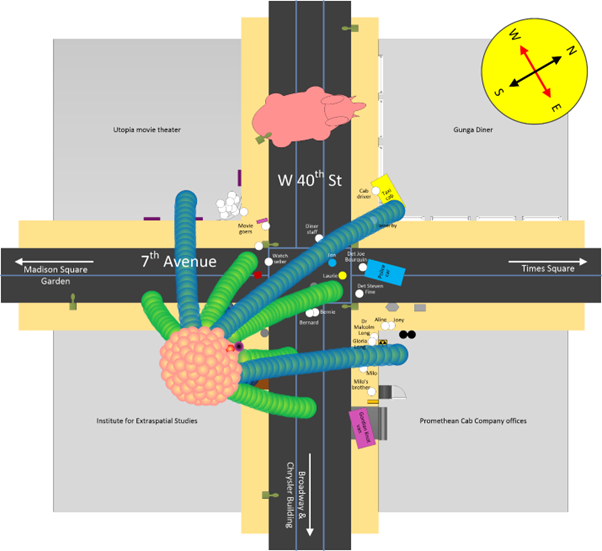
One of the things that grabbed me about Watchmen was all those scenes at the intersection of two streets somewhere in New York: the man at the newsstand and the kid next to him leaning against an electric hydrant thing, reading Tales of the Black Freighter; the fabulously named Gunga Diner where Dan and Laurie meet and where Rorschach stakes out his mail drop; the Utopia cinema prophetically showing The Day The Earth Stood Still; the Promethean Cab Company where supporting characters like Joey work, the guy selling watches out of a briefcase just up the street; the nuclear fallout shelter sign on the wall; the freaky 'Hiroshima shadows' image of embracing lovers spray-painted onto a wall; and of course the bland-looking Institute for Extraspatial Studies building, which is fated to be the manifestation locus of Ozymandias' creature.

The last few pages of issue #11 show many of the series' supporting characters converging by chance at that intersection. Aline has come to see her girlfriend Joey and an argument swiftly turns into a violent assault. Gloria Long is quizzing Bernard the news seller about her estranged husband Dr Malcolm Long before spotting him down the street. Detectives Steven Fine and Joe Bourquin are driving by, possibly on their way home. Milo from the cab company and his locksmith brother Ralph are going for a drink after work. The Utopia is packed with moviegoers and just down the street hundreds of knot-topped music lovers are attending a Pale Horse/Krystalnacht concert.

Then there is a bright, white light from inside the Institute for Extraspatial Studies and everybody dies.
Those wide-screen panels at the bottom of the last few pages of issue #11 show the fantastic draughtsmanship of Dave Gibbons, doubtless directed by Alan Moore's characteristically detailed script. We see the lives of these secondary and tertiary characters colliding – literally in some cases – as their personal storylines lead to a climactic resolution. In another book, these people might emerge from this incident more or less in one piece. They would grow and learn from the encounter on that fateful street corner and perhaps end up as better, wiser human beings. But this is Watchmen, and Moore and Gibbons have just killed them all with a giant telepathic squid monster.

The first few pages of issue #12 describe the aftermath of the catastrophic event in graphic splash pages, dialogue-free until Jon and Laurie turn up in the middle of the carnage. We see the bodies, limp and bloody, strewn across the street, hurled against walls. We see vehicles embedded in restaurant windows and heaps of corpses spilling down the steps of the Utopia. We see the monster itself, a bulbous obscenity complete with titanic tentacles and what I can only describe as a bloodshot 'eye-gina' bursting out of the shell of the institute. It's a powerfully cinematic sequence of scenes.

Not only are those splash pages powerful, but taken as a whole they're incredibly precise and consistent; you see a leg in one page and it matches up perfectly with an outstretched body seen from another viewpoint on another page. Just like the entire Watchmen series, it all matches up beautifully like an intricately disassembled clock, waiting for the reader to piece it all together in their mind's eye. Carnage yes, but beautiful in its way.

Somewhere around my second or third rereading of Watchmen back in 1987, I started to get ever so slightly obsessed about those streets, those corners and buildings where it all happened. I wanted, needed, to be able to visualise it as a whole as Moore and Gibbons must have done, to see exactly which building faced which, to work out who worked at which corner, to figure out how close they all were to the monster when it appeared. So I studied the source material for a bit, deduced what went where and drew a little map on some lined paper (see below). I showed the map to my comic-reading wingman Ian and then folded it up inside the Watchmen trade paperback and subsequently forgot about it for 30 years.

My hand-drawn map from 1987


Then Pádraig (Ó Méalóid) invited me to join the editing team for this issue of Journey Planet, and I thought about digging out my old map and maybe redrawing it. Maybe a bit neater on the computer, and labelling things up. And once I'd done a nice map of the streets before the disaster, it shouldn't be too much trouble to use it as a template for a map of the scene after the event.

I may have got a bit carried away.

Have a look at the pictures below, then keep reading to see how I worked out what went where.

W 40th and 7th: Before

Here’s how the intersection looks throughout Watchmen, up to the point that the creature appears.


W 40th and 7th: After

Here’s the intersection as it looks in Watchmen #12. The creature’s tentacles, crashed vehicles and bodies match up to the artwork as best I can manage. Jon and Laurie are indicated by the blue and yellow dots, where they first appear in that issue. 


How do we know where this is?

Fortunately, Rorschach's journal tells us that he shadows Dan Dreiberg and Laurie Juspeczyk to the Gunga Diner on 40th and 7th, which gives us the exact midtown location of the intersection, not far from Broadway and Times Square.

The problem with Madison Square Garden

In Watchmen, Madison Square Garden is clearly visible from the intersection (seemingly a block south down 7th Avenue from the Utopia). But in our real world (or Earth N as my co-editor Pádraig calls it in his article) the current fourth Madison Square Garden is further downtown, south and west on 8th Avenue between 31st and 33rd Streets, and therefore could not possibly be visible as seen in (for example) issue #11, page #24.

So in the world of Watchmen (Earth W), the current (as of 1985) Madison Square Garden must have been built in a different location to its real-world counterpart. Perhaps the existence and actions of Dr Manhattan et al caused this curious divergence in municipal planning? Maybe a Moloch or Underboss-run construction racket in the 1960s resulted in a change in the city’s zoning, or maybe the Comedian just shot the architect. We may never know, but there's probably a very niche fanfic in this. 

The Comedian's apartment

In Watchmen #1 page 4, Detectives Fine and Bourquin are seen leaving Edward (the Comedian) Blake's apartment building and shortly thereafter walking past a Gunga Diner. Does this mean that the Comedian lived just down W 40 Street from the intersection with 7th Avenue? I don't think so. The diner on page 5 sits in a building with a substantial stone corner which is quite distinct from the Gunga Diner seen in (for example) issue #2 page 4. Gunga Diner is presumably a chain, and the detectives were simply passing a different diner.

Midtown Comics

In the real world, the south-west corner of the intersection is actually the location of the original Midtown Comics, a well-known comics store visited by several of the issue's contributors (other comic stores are available). Coincidence? Probably not.

Attending a signing by Dave Gibbons earlier this year (2023) at London’s Gosh! comic shop, I had a chance to inflict my Watchmen streetmaps on him, which he graciously approved of and confirmed that he used his old building surveyor skills to meticulously plan out the layout of the intersection. As if there was any doubt.

References

As well as Gibbons’ faultless artwork, I drew upon actual streetmaps of Manhattan and the following resources:


The work of AYBGerrardo, who I later discovered had undertaken a similar project to mine. Sadly, the links below no longer work, but I did manage to save a copy of their annotated streetmap.
http://photobucket.com/gallery/user/AllyourbasicGerrardo/media/cGF0aDovd2F0Y2htZW5tYXAuanBn/?ref=

The Thing From Another World - a tropogram

Hello. It's been a while, hasn't it? There was that whole Covid thing for a couple of years, and other stuff. I've been busy on other writing projects - mainly tabletop roleplaying game adventures and the 80s incarnation of the 7TV miniatures game - so I've had little to no bandwidth left for sharing whimsical musings, savage comic reviews or the like here. My apologies. 

I've pinned a lot of my self-esteem to 'getting shit written and published', but my work has largely disappeared into Development Hell - for reasons beyond my control - these last 3 or 4 years, so I'm at a bit of a low ebb. It's hard to keep writing and designing and creating stuff when it's all gathering digital dust at various publishing houses.

Aaaaaanyway, I've decided to break my duck with a pretty diagram that I created yesterday (instead of doing my Real Job), for all the film/book/comic/sci-fi/horror/infographic nerds. It can't just be me, can it?

I was inspired by a recent post on the excellent Nightmare Man group on Facebook, wherein top contributor Tristan Sargent wrote another of his articles linking the various versions of the movie The Thing to its book origin (John W Campbell's Who Goes There?) to H P Lovecraft's At The Mountains of Madness (written two years before Campbell's story) and several Doctor Who stories involving Ice Warriors and Krynoids.

In the post's comments thread I joked about drawing a diagram to link all the inspirations and connections together, like one of those Rock Family Trees they used to do on BBC. Coz you know how much I like doing those sorts of things. Like I did with Alan Moore's Providence comic, and the plot of Robert Altman's Short Cuts.

So I scribbled some notes down, fired up Visio and knocked up an infographic that tracks some of the influences, forerunners, coincidences, homages, rip-offs and sequels of Howard Hawks' 1951 sci-fi classic.

I've used a colour-coded key of my own devising to track some of the common tropes like Polar Setting, Human Assimilation and Suspended Animation. Hence the term tropogram, which I have just invented.

By no means accurate or compete, I hope it's of some interest. I enjoyed putting it together.

Wednesday, 28 June 2017

The League of Extraordinary Gentlemen: 1976 & 1979

How have I never put this up? I wrote it up in 2014, inspired by a couple of homages to the excellent League of Extraordinary Gentlemen comic by Alan Moore and Kevin O'Neill.
(Not the movie. Never the movie. Which was never made.)

Like my own efforts, the spoof 1988 and 1996 incarnations of the LoEG consisted of characters from US movies, rather than Moore and O'Neill's more literary source material:
http://comicsalliance.com/top-shelf-announces-league-of-extraordinary-gentlemen-1988/
http://comicsalliance.com/the-league-of-extraordinary-gentlepersons-1996-art-parody/

Subsequent to my writing the pitches below, some of the characters I used cropped up in the ongoing comic series (see Nemo: River of Ghosts), so I guess I was in the right groove.

If anyone fancies their ability to draw decent team shots of either group, please do get in contact and save me several hours swearing at Photoshop.


League of Extraordinary Gentlemen: 1976

Gathered by the rumpled man in the hat calling himself K, a new League is assembled to face a satanic threat to America and the World:

Teenage demonic possession survivor Regan MacNeil
Fearless marine biologist Matt Hooper
Driven narcotics cop Popeye Doyle
Haunted outdoorsman Lewis Medlock
Taciturn martial artist Lee

Together they overcome Texan cannibals, murderous trucks and rampaging grizzlies before finally storming the Bramford, an unassuming New York apartment building where they must face the ultimate evil: the child Damian Thorn and his resurrected consort Carrie White.


League of Extraordinary Gentlemen: 1979

Recruited, blackmailed and in one case literally rewired by shadowy New York businessman M, a new League is tasked with putting a stop to a sinister force intent on uniting all the city's street gangs under one charismatic leader. They are:

Resourceful babysitter Laurie Strode
Never say die debt collector Rocky Balboa
Historian and runner Babe Levy
Nurse turned avenging angel Coffy
Quiet taxi driver Travis Bickle
The silent, black-clad Gunslinger

They must run a deadly gauntlet through the turf of the Gramercy Riffs, not-so tranquil Crystal Lake, past Illinois Nazis and finally to sleepy Stepford, where visionary youth leader Jack Curry and his mentor Dr Christian Szell are busy creating the perfect society.

Tuesday, 4 April 2017

Zenith: the TV series

(Originally posted on Saturday, April 1st, 2017)

Cautiously optimistic about Amazon's Zenith cast. Laurie Kynaston from Cradle to the Grave is a good choice for the lead and old reliables Walker, Nighy and Teale are spot-on for the retired superhumans of Cloud Nine.


Tuesday, 17 January 2017

Alan Moore's Providence - a plot map

Hello.

If there's the remote possibility that you - like me - are

  • slavish devotees of the wizard-author Alan Moore, 
  • obsessive-compulsive continuity freaks and 
  • strangely compelled to distil all complex structures in your life into colourful Visio diagrams to better please your 'probably some way along the spectrum' mind, 

then you may be interested in this pictorial project I have just completed.

It's a stupidly complicated plot map of his latest HP Lovecraft-inspired comic series Providence.

As well as charting all the characters, locations and objects in a delightfully rainbow-hued explosion of arrows and polygons, there are supplementary pictures laying out specific areas of interest such as the methods of prolonging life as detailed in the story, a timeline of St Anselm's college and a timeline of the sinister Worshipful Order of the Stella Sapiente.

I'm going to lie down now.

YLYL YR NHHNGR.


UPDATE: Below is the complete, revised and reviewed - by none other than Alan Moore himself - plot map, which is more pleasingly shaped than the previous version. Much like the roiling nuclear chaos of Great Azathoth.


Monday, 10 October 2016

Grand Anciens - a partial translation

Long time readers may recall a frivolous piece I wrote some time ago which made mention of a French graphic novel called Grand Anciens, by Jean-Marc Laine and Bojan Vukic.

http://chocolate-ocelot.blogspot.co.uk/2013/02/the-chocolate-ocelots-bookpile.html


It's a mixture of Herman Melville's Moby Dick and H. P. Lovecraft's dark mythos god Cthulhu. It looks lovely and has a particularly fine cover, but it's in French, and unlike a few other popular graphic novels like Blueberry and Blacksad, it hasn't been translated into English.

Over-ambitious fool that I was, I thought I might be the person for the job.

I managed eight and a bit pages. Jeez, 19th century French whaling terminology is hard to translate. And this self-imposed project has hung around my neck like a Gallic-Cthulhu-shaped millstone ever since

So the time has come to put away failed projects like this and move on. I'm giving the Grand Anciens book(s) away and putting the sorry affair out of my mind. But to preserve what little progress I made for anyone who fancies getting ahold of a copy and continuing my work, I include here the first few pages and my efforts and translation.


Grand Anciens, or The Great Old Ones
Part 1: The White Whale
By Jean-Marc Laine and Bojan Vukic
Translated into English by Helena Nash


Page 3
Caption:               The whaling port of New Bedford
…on the Atlantic coast of Bristol county, in Massachusetts…
…a misty autumn in the middle of the 19th century…
Caption:               My name is Ishmael.
Melville:               So.
Tell me, my young friend Ishmael…
…you want to be a sailor?


Page 4

Melville:              What could induce a well-respected, educated young man to share the life ​​of salt, blood and death of whalers?
I’m quite curious to learn the answer to this mystery!
Ishmael:               I’m afraid I have no extraordinary reasons like those in the great novels.
My life wouldn’t even warrant a chapter, Mr Melville.
Melville:               Nonsense, my young friend. Don’t be so modest.
I tell you, if I were to look for characters, I’d have my hands full. Look around us. The Admiral Benbow is full of characters.
Ishmael:               “The Admiral Benbow”! The landlady was having a laugh when she named her inn!
Melville:              Oh, Moira’s not the landlady. She just serves the beer and kicks drunken sailors out the door.
The real landlord’s James Hawkins. His story’s well-known throughout Bristol county. People say he found treasure and built several inns like the one in which he grew up in England.
The inns are all called “The Admiral Benbow”, and they all serve the same English beer!
Ishmael:              The same English beer? That’s stupid! Why would people want to drink the same beer in places that all look alike?
Melville:              Haha! The world is full of surprises.
Melville:              I believe that you do have reason, my young friend Ishmael.
You want to board a ship and travel the world. You’ll love it!


Page 5

Melville:               Yes, truly, the life of a sailor will teach you much.
But you already have your sea legs, if I am not mistaken.
Ishmael:               You… you know how to read people, Mr Melville…
Melville:               It’s my job, my young friend.
Ishmael:               I… don’t know where to begin.
Melville:               At the beginning. What convinced you to leave the merchant navy?
Caption:               The open sea, Mr Melville. The sea!
Look at New Bedford! This town sprang up thanks to the whaling industry! Look at the ships, all the inns and the stalls that live off that trade.
And Nantucket, off the coast! It’s the greatest whaling port of them all, greater even than New Bedford…
Nantucket is Whale Town! They’ve got a whalers’ chapel over there!
Ishmael:              It even seems that when a girl gets married in Nantucket, her father gives a whale as a dowry!
Melville:               You wouldn’t be a little obsessed by sperm whales would you?
Ishmael:              Obsessed? Me?
No! Not at all!
Ishmael:              Don’t be angry, my young and impetuous friend!
Obsession is something I can understand, believe me!


Page 6
Ishmael:               You’re obsessed by what, mister writer? Sailors?
Melville:              This will surprise you, Ishmael, but I have found something more exciting than sailors or the creatures of the sea.
Even though sea monsters fill many pages of this notebook.
Melville:              No, for my part, I am obsessed by obsession.
Or rather, fascinated by fascination.
Melville:              It’s been almost thirty years now, since the whaling ship Essex sank in the Pacific ocean.
Melville:              The Essex left Nantucket in 1819 and must have sailed for two and a half years before returning. No survivors were recovered.
Melville:              The whaling ship sank after a fight for several hours with a white whale.
Melville:               At least, that’s what they said.
Ishmael:               How’s that?
You think that it wasn’t a sperm whale that destroyed the Essex?
Melville:              The story that I am going to tell you, my friend, goes back several years and has as a protagonist Captain Ahab when he still had both legs.
Have you heard of Captain Ahab, Ishmael?


Page 7

Caption:               What I am about to recount to you took place some years ago.
As usual, Captain Ahab was on the quarterdeck.
Standing.
The look-out alerted the crew as he spotted their prey…
…the white whale!
The sailors had seen the snowy white, wrinkled head of a great sperm whale, and the Pequod sped over the waves in the wake of that gigantic shroud-coloured body.
On his two legs, Ahab kept his eyes fixed on the whale.
His form seemed cast in bronze, and his skin was that of a man pulled from the pyre just as the flames were about to consume him.


Page 8


Caption:               The harpooners were like javelin throwers.
Stubb was Ahab’s second mate during that time. He was without equal at harpooning whales.
Stubb:                   Onward lads! Onward!
Caption:               Whalers who took to the sea flew over the waves, and cut through the water like air.
And the harpooner cried: “Make it afraid! You’re like the thunder!
The crewmen followed Stubb as they followed the other mates Starbuck and Flask.
Because as well as being their bosses, they were also sailors.
And because they were on the Pequod.
And because Captain Ahab was at the helm.


Page 9

Caption:               You will discover many things when you sign on with your first crew, Ishmael!
You will learn the tales and legends of the ocean.
You will listen to the most incredible stories, like the one about the white whale being everywhere at once, and in both hemispheres at the same time.
You will hear stories about the wildest fishing, the farthest voyages, and you will learn that your fellow sailors are a taciturn and secretive breed of men, but superstitious.
Because among the fables that plague the hearts of men, they will tell you of the scourge of the whalers…
… the Wrecker
… the Kraken!


Page 10

Ishmael:               The Kraken?
Are you…
Melville:               The sea is full of myths, especially for whalers…
Caption:               …and Captain Ahab is a sailor, without a doubt one of the best.
He knows the legends that frighten his crew. He knows that men of the sea, who come from all walks of life and speak every tongue, invent stories to warm the heart…
…stories that end up haunting them.
Ahab is not a man who believes in bogeyman tales.
But the captain is a man of decisions.
Quick decisions.
Ishmael:               And what did Captain Ahab decide to do?
Set sail to hunt the Kraken?
Melville:               It’s not that simple.


Page 11

Melville:               Rumours being what they are, they spread.
While they circulate and the sailors are still on deck, running scared or with laughter on their lips, it doesn’t matter.
But when it comes to pass that sailors refuse to go to sea, then it’s the turn of the owners to be concerned.
Ishmael:               You seem to know all of the workings of New Bedford, Mr Melville.